
Population Health Management Network
The PHM network is THE forum for anyone with an interest in PHM. We encourage professional registration via industry bodies such as FEDIP and AphA. This shows not only that your skills have been validated and independently assessed, but that you are passionate and committed to the health and care data and analytical profession.


Our purpose
PHM continues to feature in national health policy and underpin localised approaches to the ongoing needs of our populations. AphA want to empower people like you to make a meaningful difference in the lives of communities by equipping you with the skills and tools needed to identify health trends, address disparities, and develop targeted interventions that promote prevention and early intervention.
Professional Support
Ultimately, a greater understanding of PHM allows you to contribute to creating healthier, more equitable communities, improve patient outcomes, and advance your professional development in a rapidly evolving healthcare landscape.
May the data be with you!
Community
By being a member of the network, you can enhance your analytical expertise, collaborate with a wide range of professionals, and stay updated on the latest innovations and best practices.
Please follow us on LinkedIn and use these hashtags when posting #statsandstories
#insightinaction
Population Health, Healthcare and Health Management
The first step is to clarify the meaning of the terms in common use
Population health means the health status of a defined group of people.
Population health management was originally a method which stratified the population by levels of risk, allowing resources to be focused on those subgroups at highest risk. The need for it was emphasized in the new Neighborhood Health Guidelines which emphasized the need to Apply a single, consistent system-wide population health management method to ICB analytics platforms to segment and risk stratify populations, based on complexity and forecasted resource use. The guidelines also emphasized that a population health management approach should be supported by a system-wide intelligence function used to:
- inform strategic commissioning and resource allocation
- enable providers to work together to best organise their workforce to deliver health and care
Population healthcare is a term used to describe an approach that segments the population vertically into groups with a common need such as depression or back pain or Parkinson’s disease or a common characteristic such as frailty in old age, not on institutions, or specialties or technologies. Population medicine is one aspect of population health in which a sub set of clinicians in primary and secondary care, for example one clinician in each specialist service is trained in the principles of population healthcare and given responsibility and time, even one half day a week to strengthen links with the population served, for example by working with general practice reviewing referral from different segments of the population to identify inequity.
The relationship between these two perspectives is best understood by a diagram
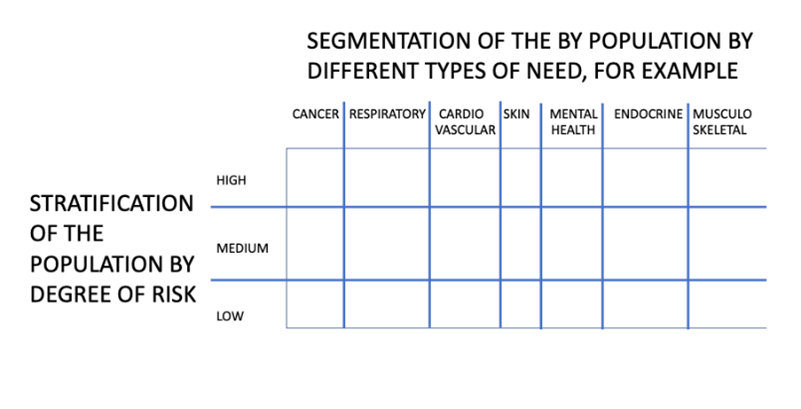
The segmentation perspective, supplemented by programme budgeting offers the opportunity for identifying unwarranted variation in activity and spend and therefore waste and inequity and will be essential for optimising value.
Muir Gray
Chair Profiles

Muir Grey
Muir Gray entered the Public Health Service in Oxford in 1972 after qualifying in medicine in Glasgow. Muir is an internationally renowned authority on healthcare systems and has advised governments in several countries outside the UK, including Australia, New Zealand, Italy, Spain and Germany and regularly delivers plenary sessions at international events.
Muir has worked with NHS England and Public Health England with the aim of increasing value for both populations and individuals and published How To Get Better Value Healthcare in 2007, having been the first to use the term value based healthcare in the second edition of his book Evidence Based Healthcare in 2001. The means of doing this through Systems and Personalisation is now called Population Health Management, the aim of which is to maximise value and equity by focusing not on institutions, specialties or technologies but on populations defined by a common symptom such as breathlessness, Type 1 or Type 2 Diabetes or a common characteristic, such as multiple morbidity.
Muir is the Founding Director of the Oxford Value & Stewardship Programme (www.obsp.net) in Oxford, working with organisations throughout England, Scotland and Wales and also internationally with leading organisations in Brazil and the Kingdom of Saudi Arabia.
Recently Muir has returned to his first public health mission – preventing the changes we assume are due to ageing and disease by getting the right attitude and fighting back against an environment that makes us inactive and lose physical, emotional and cognitive wellbeing. His key books include Sod 70! and, with Diana Moran, Sod Sitting, GetMoving! Muir leads the Optimal Ageing Programme in Oxford www.theoptimalageingprogramme.net

Rachel McIlroy
Rachel has almost twenty years of NHS experience including nine years with NHS England. Her background is in healthcare analytics, data management and visualisation for decision making, and population health management.
She is a proud member of AphA and the CDAO network as well as a Chartered Statistician of the Royal Statistical Society. She has been working in NHSEs National Population Health Management team since early 2022 and is passionate about supporting teams to develop their data infrastructure and intelligence functions as well as promoting analytical workforce professionalisation and development across all system partners.
Rachel combines her statistical expertise with a deep understanding of population need, enabling the development of tailored interventions that improve outcomes and enhance patient experiences. Understanding that successful system transformation requires a comprehensive approach including social determinants of health, she works across sectors to address the unique challenges faced by diverse populations, enabling stakeholders to make informed decisions about resource allocation and long-term sustainability.

Huw Davies
Huw is a management consultant for Davies Furlong Consulting, Trainer with the Consortium for Healthcare Analytics INtelligence (CHAIn), and has worked with the data profession in health and care for the past 25 years. Acting as Commercial Director, Huw is also the Chief Operating Officer for the newly formed Data Observatory CIC. The brains behind the National Competency Framework for Data Professionals in Health and Care, Huw led the project to deliver Strategic Commissioning Training to the North East via the Growth and Health Accelerator Programme.
Recently awarded his PhD in Decision, Risk, and Analytics from Southampton Business School at the University of Southampton, Huw successfully evidenced his theory to reduce miscommunication in the NHS by 80% using systems thinking and phenomenology. Comic genius, former age grade rugby international and professional player and coach, and all-round legend. Terrible guitarist.