
Clinical Coding Leaders’ Network
The Network is a UK-wide professional community committed to empowering, connecting, and advancing the clinical coding profession. Founded by Katie Campbell ACC, TAP.dip LFEDIP and Carolyn (Caz) Cooper ACC, MBA, FCMI senior leaders, the network was created to provide a unified voice and strategic support in response to growing challenges in the field.
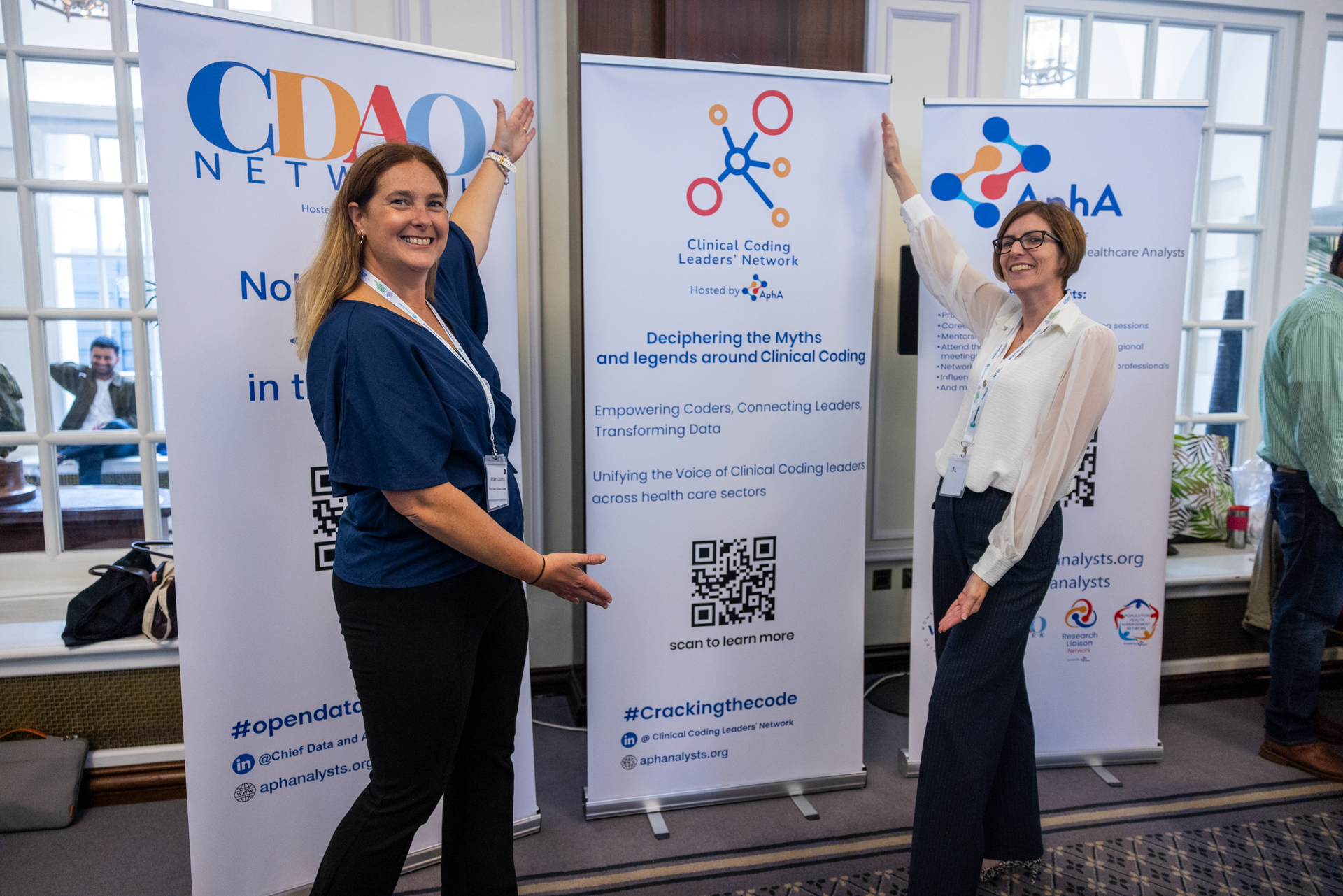
Deciphering the myths and legends around clinical coding
The Clinical Coder of the Future
By Katie Campbell ACC, TAP.Dip, LFEDIP – Co-Chair of Clinical Coding Leaders Network.
Head of Coding and PbR Assurance & Kent and Medway Strategic Coding Lead
If we look at Clinical Coding as a profession today, we are working in a system that considers Clinical Coding as an admin or ‘back office function,’ which couldn’t be further from the truth. In the UK, Clinical Coding — the translation of patient diagnoses and treatments into internationally recognised codes — is often hidden from patients and frontline staff, which is why we are still seen as a backroom function rather than a vital part of healthcare delivery
The Clinical Coder of the future will no longer be seen as purely a ‘back office function’, but as a ‘subject matter expert’ at the intersection of clinical practice, data science, and digital health. As AI-driven tools and natural language processing become more embedded within healthcare, much of the initial data extraction from patient records will be automated. However, AI can only take coding so far. The future Clinical Coder will step into the role of expert validator and interpreter — ensuring that the data produced by machines is not just fast, but also clinically accurate, compliant with standards, and meaningful for patient care and funding.
This future role will involve:
– AI Collaboration: Working alongside AI systems that extract diagnoses, procedures, and clinical details, ensuring outputs are clinically valid, contextually accurate, and coded to national standards.
– Clinical Collaboration: Engaging more closely with all healthcare professionals to clarify complex cases, resolve ambiguities, and guarantee that coded data reflects the true patient journey. In more data mature countries like the United States and Australia, coders often already work in closer partnership with clinical teams — a model the UK could learn from as we strengthen the coder–clinician relationship to improve data quality.
– Data Quality Leadership: Continuing as they do now as the guardians of coding quality, ensuring that records drive accurate NHS reimbursement, performance monitoring, research, and policy decisions.
– Analytical Insight: Using their expertise to spot trends, discrepancies, and potential data quality risks that machines may miss.
– Education and Advocacy: Expanding on current work helping all users of Clinical Coded data to understand the impact of documentation on coding and data accuracy, and advocating for the role of coding within the wider healthcare ecosystem.
As we move into a future of AI–coder collaboration, a key question emerges: Is the information available in clinical records truly sufficient for AI to extract? AI can only process what is documented. If clinical notes are incomplete, ambiguous, or inconsistent, the extracted data will be flawed. Coders of the future will play a vital role in flagging documentation gaps and working much more closely with clinicians to improve the quality of patient records. Without accurate and detailed clinical input, even the most advanced AI will be unreliable. This means that documentation improvement and coder–clinician collaboration will become even more important if not essential, in the era of automation. Ultimately, the Clinical Coder of the future will be less about being seen as a ‘Admin/back office function’ and more about curating and validating data at scale, making sure that what comes out of AI systems truly reflects patient care. AI will do the heavy lifting, but Clinical Coders will remain the essential experts who ensure that healthcare data is correct, complete, and trusted.
We must act now in order to shape the future role of the Clinical Coder.
The Clinical Coders Leaders Network will set out a roadmap to support the Clinical Coding profession as we transition into the future, be part of the change and join me at Clinical Coding Leaders’ Network – AphA – Association of Professional Healthcare Analysts.